Pages

Showing posts with label succulent. Show all posts

Tuesday, 23 May 2023

Aloe vera (A. barbadensis)

Ink sketch and watercolour on sketch pad

Often called the ‘Miracle Plant’, aloe vera has been used around the world for the last 4000 years.

There are many species of aloe vera plant, but only a few have tangible health or medicinal properties. Aloe Vera or “true aloe” contains over 200 different ingredients, such as:

~ Vitamins
~ Minerals
~ Amino acids
~ Enzymes
~ Polysaccharides and more

Aloe vera doesn’t actually cure anything itself; but it gives your body all the nutrients it needs to get back to its natural balance… and heal itself.


Friday, 30 September 2016

Aloe ferox painting 2

W&N watercolour on Bockingford 300gsm
Aloe ferox (also known as the Cape Aloe, Bitter Aloe, Red Aloe and Tap Aloe), is a species of arborescent aloe indigenous to Southern Africa. It is one of several Aloe species used to make bitter aloes, a purgative medication and also yields a non-bitter gel that can be used in cosmetics.

___________________________________________________________________________

Die Bitteraalwyn (Aloe ferox), inheems aan Suid-Afrika, is ’n struik wat deel is van die aalwynfamilie. Die plant blom vanaf Mei tot September. Die struik is ’n stadige groeier met ’n enkelstam en dik, doringrige, vlesige blare en buisvormige, oranje-rooi blomme. Dit is ’n uitstekende struik vir die rotstuin en verkies vol son en matige water. Die sap van die blare word vir medisyne en skoonheidsprodukte gebruik.

::
 

Monday, 12 September 2016

Aloe ferox sketch

The original is watercolour in my Moleskine Nature Journal – 8″ × 8″

Here in South Africa, the Aloes start flowering in June/July, our coldest winter months, and for me the amazing thing is that, in the Northern Hemisphere, like France, they also flower in July, but during their summer. Some internal clock dictating the flowering time?

I did this sketch of this Aloe ferox (Bitter aloe) in my garden in August 2009, after I had noticed that the Blackbirds were all visiting this one, and the reason was soon apparent – it was fairly dripping with nectar! The flowers always seem to produce the most nectar just as they’re getting to the end of their life-span, which is early Spring. It’s their special gift to nature.

This hardy plant with its succulent leaves can survive the harshest conditions. When damaged by man or animal, the plant seals off any wound with a sticky, dark liquid that prevents infestation by virus, fungus or insect. This dark liquid has been successfully used by ancient inhabitants as a traditional remedy for many ailments.

The white inner gel of the leaf has the ability to hold and store moisture through hot, dry conditions and months of drought. Traditionally, the local inhabitants use it to soothe burn wounds, cuts and abrasions. Today those same qualities are still the being used in a wide range of moisturizers and rejuvenating creams and gels.

Wednesday, 7 September 2016

Echeveria imbricata


Ink sketch and watercolour in Moleskine Watercolour sketch-book – 8″ × 5″

I’m absolutely mad about Echeverias and have a small section in my garden set aside just for them. My collection started off in the late 70’s when my father gave me three rosettes in a pot, which I transplanted into a rockery and soon they covered the whole area. Since then I have given away hundreds to friends, the geese got out of the pond area and made a hearty meal of them and they’ve survived many of the severe frosts we get in our area.

Saturday, 2 April 2016

Echeveria imbricata in terracotta pot

W&N watercolour on Bockingford 300gsm

 An Echeveria in a pot on my patio (Tarlton, Gauteng, South Africa)

This popular and vigorous succulent has 4 to 8 inches wide, tight rosettes of flat grey-green leaves that, when mature, form offsets freely to form large solid clumps 4 to 6 inches tall. It has a branched arching inflorescence bearing clusters of red and yellow flowers in the spring and early summer. Plant in full sun, even in hotter inland gardens, to part sun/light shade in a well-drained soil and water regularly. Although it is is cold-tolerant, it does not do well in heavy frosts, therefore most of mine are planted in terracotta pots for easy winterizing.

This plant is often listed as a species or as E. x imbricata but is a hybrid cultivar created in the early 1870’s by Jean-Baptiste A. Deleuil of Marseilles (Rue Paradis) that resulted from crossing Echeveria secunda with E. gibbiflora ‘Metallica’ and was listed for the first time in his 1874 catalogue.

It has been argued by some that the correct pronunciation for the genus is ek-e-ve’-ri-a, though ech-e-ver’-i-a seems in more prevalent use in the US.

Category: Succulent
Family: Crassulaceae (Stonecrops)
Origin: Mexico (North America)
Evergreen: Yes
Flower Color: Red & Yellow
Bloomtime: Spring/Summer
Synonyms: [Echeveria x imbricata]
Parentage: (Echeveria glauca x E. gibbiflora ‘Metallica’)

Thursday, 24 March 2016

Aloe flowers - Nature's silent healer

W&N watercolour on Bockingford 300gsm

Several Aloes have flowers with nectar that can be consumed. Among the sippable blossoms are A. ferox and A. marlothii. A. zebrina has edible flowers and buds after being boiled. In Angola they are pressed into cakes. A. greatheadii flower buds are a delicacy after being boiled in three changes of water. There is no report on the edibility of Aloe vera flowers. But since that plant is medicinal, I would not eat them.

The genus is native to Southern Africa.

Saturday, 19 March 2016

Grass Aloe


Watercolour sketch of A. cooperi in my ‘Nature’ Journal


In the hope of reaching the moon
men fail to see the flowers
that blossom at their feet.

- Albert Schweitzer

I found a large clump of Grass Aloes not far from home on the road to Magaliesburg (South Africa), flowering profusely after all the veld fires we had this past winter, spread out over the charred landscape, providing bursts of red colour.

Grass Aloes are an appealing group of deciduous aloes. As the name implies, they grow mainly in grasslands subject to winter fires. Their leaves and colours resemble their habitat, making them difficult to find when not in flower. These largely miniature aloes have very attractive flowers, making them desirable, if difficult, plants to cultivate. Their growing pattern is closely related to the winter fire cycles of the veld here in South Africa, some species responding directly to burning and producing leaves, flowers and later seed after such events.

This interesting Aloe belongs to a group of deciduous aloes known as the “Grass Aloes”, which are adapted to grassland habitat and are able to survive both fire and frost during the cold dry months. They are often burned during winter and then re-sprout with the onset of spring.

This well known grass aloe is commonly found along rocky ridges and rocky slopes on the Witwatersrand and Magaliesberg as well as in mountainous areas of the Northern Province and Mpumalanga. In years gone by it was even more prolific, but numbers have been greatly reduced due to development on the ridges and from harvesting by succulent collectors. A number of different forms are found throughout its distribution range.

Grass fires used to be less frequent in earlier centuries. They were initiated by lightning strikes, on the whole, at the beginning of the rainy season in September and October. These fires were ideal in that they cleared the habitat of moribund grass and other vegetation just before grass aloe species initiated their growth cycles.

Fires are more frequent nowadays and may occur at any time during the dry winter months from May until late spring, October. Plants are as a result, left exposed to harsh conditions for many months before they start to grow. Some species are even starting to appear on the endangered species list.

Tuesday, 15 March 2016

My Aloe route

Ink sketch and W&N watercolour on Bockingford 300gsm

This is the road I take (I call it ‘my aloe route’) when I go to visit a friend in New Thorndale just on the other side of Magaliesburg (Gauteng, South Africa). There are dozens of Aloes along a certain rocky outcrop and it winter it’s a wondrous display when they all flower.

::

Saturday, 12 March 2016

Mother-in-law's tongue

W&N watercolour on Bockingford 300gsm

A pot of Mother-in-law’s Tongue (Sansevieria trifasciata laurentii).

Indigenous to South Africa, it is also known as the Snake Plant. It is a truly remarkable and striking easy care house plant native to tropical West Africa from Nigeria east to the Congo. I remember my dad having one on a windowsill in our house, where it stood for absolutely years without any seemingly extra care. The modern trend in the average home is to keep the plant separate from others and have it standing bold and alone.

Summer growers. As with all succulents, Sansevierias require a well-drained mix and moderate watering. Water frequently during the warmer months and keep fairly dry through winter. To maintain their best shape and colouration they are best grown in dappled sunlight. Grows up to 3 or 4 feet tall.

Propagation is by division or leaf cuttings. Sansevieria is easy to divide because it has shallow roots. Simply turn the pot on its side and pull out the entire plant. Use a sharp knife to cut through the thick roots and pot each clump separately. To propagate Sansevieria by leaf cuttings, cut leaf into 2-inch (5 cm) pieces and place them right side up (the way they were growing) in moist perlite or cactus potting mix.


::

Tuesday, 8 March 2016

Euphorbia cooperi

W&N watercolour on Bockingford 300gsm
 
Euphorbia cooperi (or Lesser Candelabra Tree, Transvaal Candelabra Tree, Bushveld candelabra euphorbia), is indigenous to South Africa. Found in KwaZulu-Natal, Mpumalanga, Gauteng and Swaziland up to Messina in the Limpopo Province, prefers well-drained soils and is mostly found in rockier places, often on granite outcrops and in rock cracks or in wooded grassland and thorny scrubland, in planes and in steep hillsides on north-facing slopes. This spiny succulent grows 4-7 m tall and produces small yellowish-green flowers in spring and summer.

Friday, 4 March 2016

Echeveria imbricata in wooden planter

W&N watercolour on small Bockingford 300gsm 

Echeveria imbricata in a wooden crate on my patio. Contrary to the belief that succulents are drought resistant, this Echeveria (E. imbricata) thrives on good soil and lots of rain.


::

Monday, 29 February 2016

Aloe Sunset

Aoe marlothii at sunset watercolour in hand-made sketch-book with satin-finish linen paper

The fiery aloe in full bloom, the smell of the fragrant wild sage on a dewy morning and a beautiful sunset – a typical African Bushveld scene that makes one’s spirits soar!

Indigenous to South Africa, A. marlothii (also called the Mountain aloe) occurs from the North-West Province, Gauteng, Limpopo, Mpumulanga, Swaziland, Zimbabwe, Botswana and Mozambique to KwaZulu-Natal north of Durban, from sea level to 1 600 m.

.

Friday, 26 February 2016

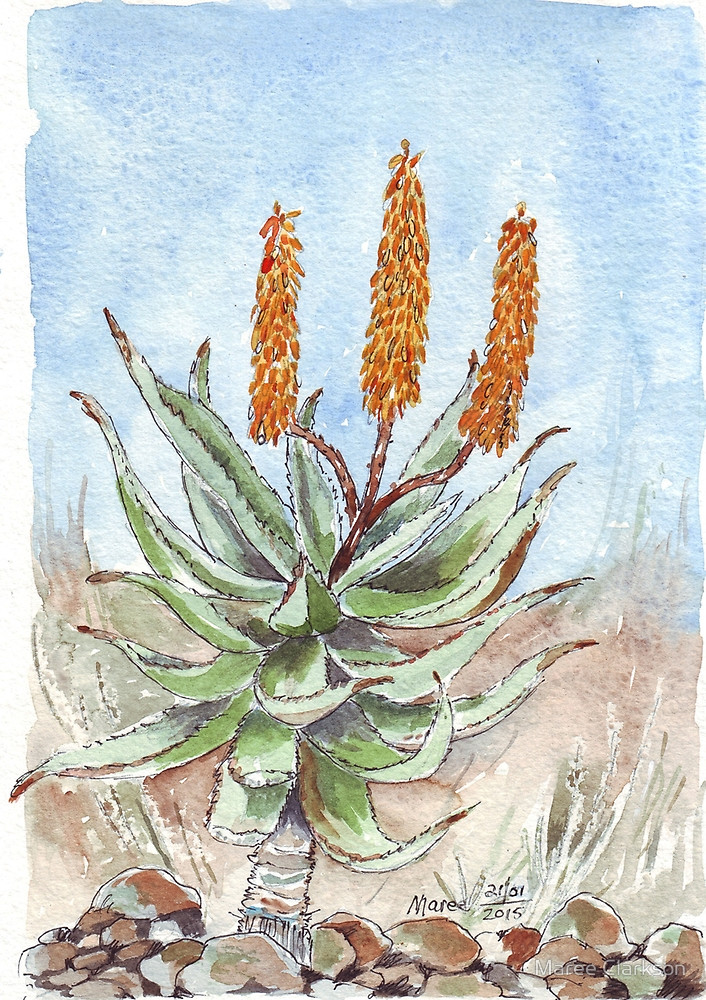
Aloe ferox in my garden

W&N watercolour on Bockingford 300gsm

Aloe ferox (also known as the Cape Aloe, Bitter Aloe, Red Aloe and Tap Aloe), is a species of arborescent aloe indigenous to Southern Africa. It is one of several Aloe species used to make bitter aloes, a purgative medication and also yields a non-bitter gel that can be used in cosmetics.

::

Die Bitteraalwyn (Aloe ferox), inheems aan Suid-Afrika, is ’n struik wat deel is van die aalwynfamilie. Die plant blom vanaf Mei tot September. Die struik is ’n stadige groeier met ’n enkelstam en dik, doringrige, vlesige blare en buisvormige, oranje-rooi blomme. Dit is ’n uitstekende struik vir die rotstuin en verkies vol son en matige water. Die sap van die blare word vir medisyne en skoonheidsprodukte gebruik.

::

Monday, 22 February 2016

Cactus Trichocereus

W&N watercolour on Bockingford 300gsm – 12″ × 8″

A cactus in a pot in my garden (Tarlton, Gauteng, South Africa) – Echinopsis hybrid. Columnar or Torch cactus. Native to the Andes Mountains, South America. It has withstood many a winter’s frost. The other cactus is wishful thinking on my part!

“The cactus thrives in the desert while the fern thrives in the wetland.
The fool will try to plant them in the same flower box.
The florist will sigh and add a wall divider and proper soil to both sides.
The grandparent will move the flower box halfway out of the sun.
The child will turn it around properly so that the fern is in the shade, and not the cactus.
The moral of the story?
Kids are smart.”


A great Tote bag to keep all your string, secateurs and other gardening tools close-by. 

::

Thursday, 18 February 2016

Young Aloe ferox

W&N watercolour on Bockingford 300gsm
In my garden (Tarlton, Gauteng, South Africa)

My experience is that this aloe (A. ferox) spreads easily from seed – from my original three plants, I now have over ten. They have sprung up all over the garden, obviously from seeds dispersed by the wind and birds. The only problem is that some of them are in unwanted locations and now I have the job of moving them to more suitable spots. But a chore I’m going to enjoy!

Aloe ferox (also known as the Cape Aloe, Bitter Aloe, Red Aloe and Tap Aloe), is a species of arborescent aloe indigenous to Southern Africa.


Thursday, 11 February 2016

Graptoveria "Fred Ives"

W&N watercolour on Bockingford 300gsm

A succulent given to me by a friend a couple of months ago growing in a pot in my garden (Tarlton, Gauteng, South Africa)

Category: Succulent
Family: Crassulaceae (Stonecrops)
Origin: Mexico (North America)

x Graptoveria ‘Fred Ives’ – A beautiful and durable succulent plant that produces large clumps of rosettes to 8 inches tall by nearly 1 foot wide with broad bronze and pink succulent leaves atop short stems with 1’-2’ long branched inflorescences bearing red-orange centered pale yellow flowers in summer. Plant in full to part sun in a well-drained soil. Little irrigation required.

The leaves are broad and stiff, overlapping each other, with concave upper surface, rubbery to the touch, waxy pearly-bronze to purplish yellow-orange to blue green (depending on time of year and growing conditons). Often shading from grey-blue at the centre out to orange-bronze-purple. The purple blush is fairly consistent throughout the seasons. Higher light and heat seem to increase the purple a bit, though.

This is a vigorous plant and is great as a container specimen or in the ground in well-drained soils or raised planters. It is reportedly a hybrid of Graptopetalum paraguayense crossed with a plant in the Echeveria gibbiflora complex.


::
 

Wednesday, 3 February 2016

Aloe ferox painting 1

W&N watercolour on Bockingford 300gsm

A painting of an Aloe ferox in my garden. Each winter my aloes put up the most spectacular show of orange, brightening up the dull winter landscape. I can feel the season is turning already, gets lighter much later in the mornings and soon (well, roundabouts June/July) I’ll be blessed with their beauty again.
Aloe ferox (known as the Cape Aloe, Bitter Aloe, Red Aloe and Tap Aloe), is a species of arborescent aloe indigenous to southern Africa. It is one of several Aloe species used to make bitter aloes, a purgative medication, and also yields a non-bitter gel that can be used in cosmetics.


::


Sunday, 24 January 2016

Aloe peglerae

Parker fountain pen, black ink and W&N watercolours on Bockingford 300gsm watercolour paper

All the Aloes are in full flower and the winter got all 3 of my Aloe ferox, burnt the flowers brown. This is Aloe peglerae, which I saw in the veld on the way to Magaliesburg, endemic to South Africa occurring only in Gauteng and one other province (North-West province). It is listed in the Red Data list of South Africa as an endangered species on the extinction queue if not protected or grown for ex-situ conservation.